
Checking Criminal History in Ashland County
A complete Ashland County records check is layered because no single database holds every part of a case. Start with Wisconsin Circuit Court Access, often called WCCA or CCAP, for filed Wisconsin circuit cases. Narrow a name search to Ashland County and compare the birth date, case type, filing date, and status. A case number is safer than a name when it is known. WCCA is a public docket, not a certified copy service, and the site does not provide every underlying document.
Next, match the question to the custodian. The jail can confirm present local custody. The arresting agency keeps its own narrative. The circuit clerk supplies complaints, judgments, and certified court copies. Wisconsin DOJ maintains the statewide criminal-history repository. These sources can update at different times, so an empty result in one system does not settle what the others hold.
- Search WCCA by case number or name, then filter the results to Ashland County and the right case type.
- Review identity clues, charges, events, status, disposition, and judgment without combining records for people who share a name.
- Call the Ashland County Jail for current custody, or use the Wisconsin DOC locator for state custody or supervision.
- Request the source report from the agency that made the arrest and the full court document from the circuit clerk.
- Order a WORCS response when the goal is a Wisconsin repository check rather than a court docket.
Ashland Court Search or WORCS?
WCCA and the Wisconsin Online Record Check System answer different questions about Ashland County criminal records. WCCA shows a circuit-court case as it moves through filing, hearings, disposition, and sentence. WORCS returns a Wisconsin DOJ Crime Information Bureau response for the identity submitted. It is built from contributed fingerprint, prosecutor, court, and corrections data. That difference matters when a court case appears online but the corresponding arrest cycle has no fingerprints, or when a disposition has not yet reached the repository.
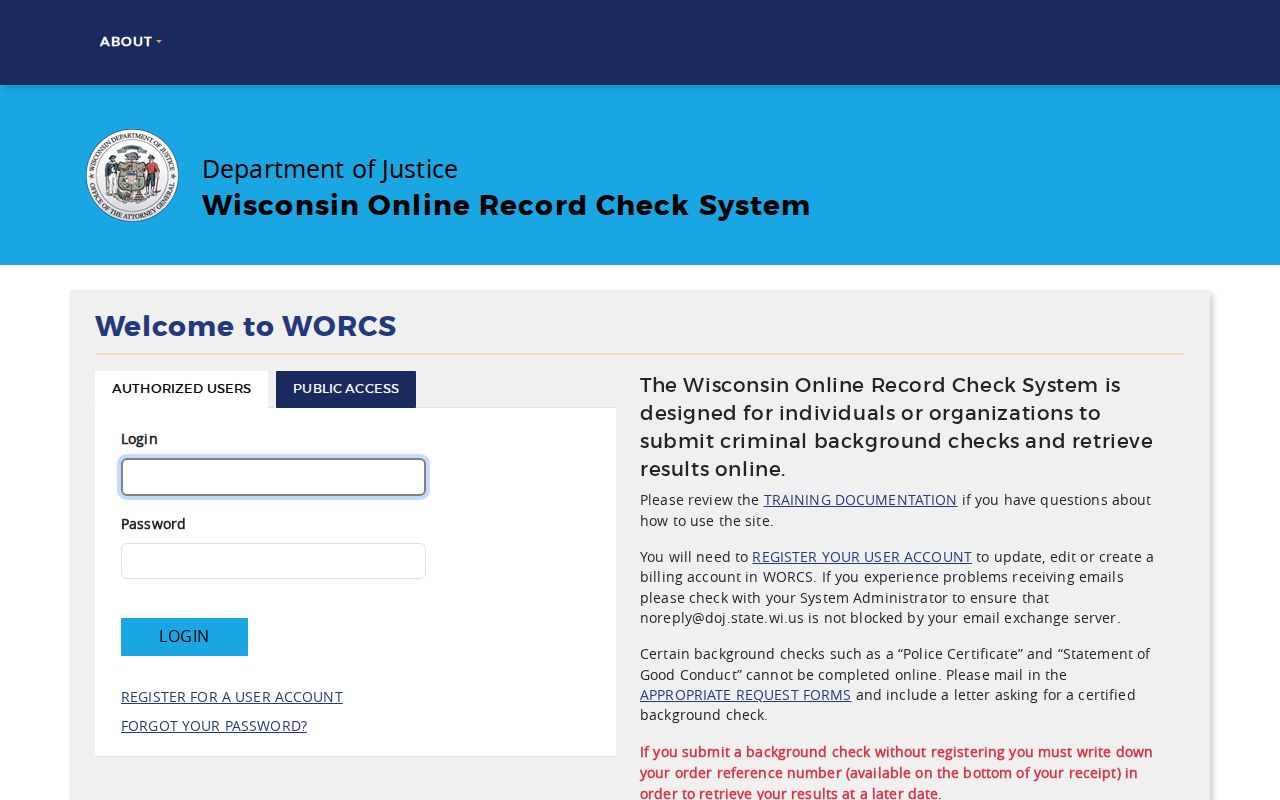
The official WORCS interface shows where a public name request begins. The image below captures the state portal assigned to Ashland County criminal-history research.
Use a docket to understand a case. Use WORCS to review the state repository response, then verify a disputed entry with the agency and court that supplied it.
| Channel | Best use | Main limit |
|---|---|---|
| WCCA | Filed circuit cases, events, charges, and outcomes | Not every document is downloadable |
| WORCS | Wisconsin name-based repository response | May omit local, federal, or unreported material |
| County custodian | Reports, booking records, and certified case papers | Each office holds only its own records |
Wisconsin Official Background Checks
The Wisconsin Department of Justice Crime Information Bureau is the state central criminal fingerprint repository. Its public product, WORCS, accepts a name-based request without a registered account. A standard request costs $7. A guest must keep the order reference number to retrieve results, which remain available for six months. Results may arrive within minutes or by the next business day. The system matches on exact identity combinations, so spelling, date of birth, and the first initial matter.
WORCS is appropriate for neutral self-review of Wisconsin repository data. It does not replace WCCA, the Ashland County Sheriff, or the FBI. A person can request their own FBI Identity History Summary through the electronic federal route, by mail, or through an approved channeler. Fingerprints are required and the FBI fee is $18.
The Wisconsin DOJ criminal-history overview explains the repository product and its limits. The assigned capture makes that official guidance visible beside Ashland County record-check instructions.
An official response should still be compared with the final Ashland County court disposition when an entry looks incomplete or wrong.
Ashland County Wednesday Fingerprints
The Ashland County Sheriff offers an unusually narrow local fingerprint window. Appointments are available Wednesdays from 10 a.m. to 2 p.m. at the sheriff complex, and walk-ins are not accepted. The published charge is $20. Call 715-685-7640, choose option 3 and then option 1, to reserve a time. Confirm the required card, agency code, and submission destination before going.
The sheriff captures the prints but does not turn the ink card into a DOJ or FBI response. Wisconsin fingerprint checks are purpose-authorized and use the DOJ/FBI workflow or Fieldprint where the governing program directs it. A person seeking their own federal summary follows the FBI route instead.
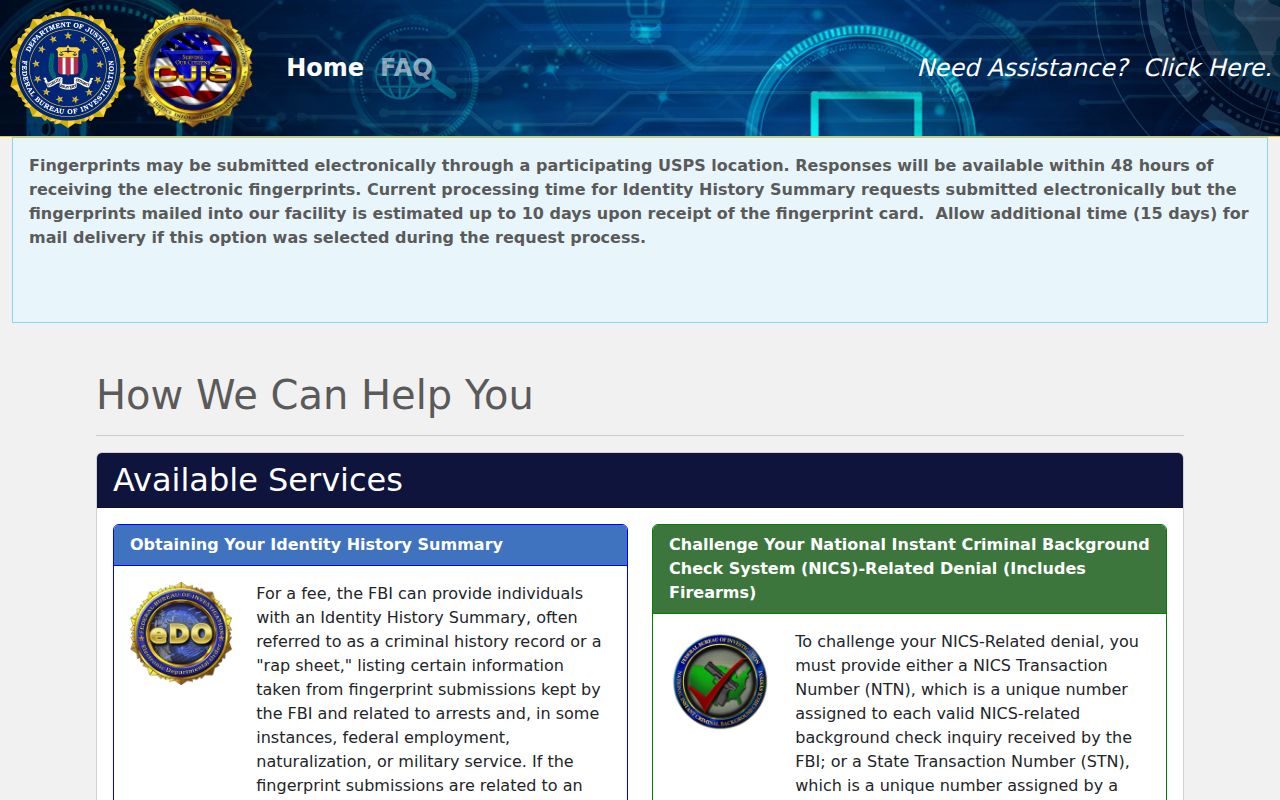
The FBI electronic request portal is the starting point for a subject’s own Identity History Summary. Its Ashland County research image shows why fingerprint capture and result retrieval are separate steps.
Keep the fingerprint receipt, request number, and any final court papers together if a challenge becomes necessary.
Criminal Record Types
Ashland County criminal records are divided by the event and the office that created them. The sheriff, City of Ashland Police, Wisconsin State Patrol, DNR wardens, tribal agencies, and other lawful authorities may create incident or arrest reports. County corrections creates the booking file. The District Attorney decides whether to file state charges, while the Circuit Court records the prosecution and judgment. DOJ then receives qualifying fingerprint and disposition data.
Custody records also split by level. The Ashland County Jail covers local intake and pretrial custody. Wisconsin DOC tracks state prison and community supervision. Federal cases and custody use PACER and the federal Bureau of Prisons, not WCCA or the county jail.
- Incident report
- The agency narrative and investigative record, which documents allegations rather than guilt.
- Booking record
- The jail intake file with time, identifiers, presented charges, holds, bond, and release data where public.
- Circuit case
- The court file containing the complaint, motions, events, pleas, disposition, judgment, and sentence.
- CIB history
- The fingerprint-supported Wisconsin repository record assembled from contributing justice agencies.
- Registry record
- A DOC public-safety profile for a person subject to registration, not a complete criminal history.
Two Ashland County Record Buildings
The courthouse and sheriff complex are separate record centers. The Ashland County Courthouse at 201 Main Street West holds the single Wisconsin Circuit Court branch, the clerk, District Attorney, victim services, and juvenile and probate functions. The clerk on the third floor is the right source for a complaint, certified judgment, final disposition, or an older file that WCCA cannot supply. The main clerk number is 715-682-7016.
The Sheriff’s Office and jail at 220 Sixth Street East hold sheriff reports, local booking material, evidence media, and fingerprint appointments. The administrative line is 715-685-7640, nonemergency dispatch is 715-682-7023, and the jail line is 715-682-7050. Asking the creator avoids a wasted trip.
The official Ashland County directory anchors these local office routes. Its assigned image places the county government source next to the Ashland County criminal record offices it identifies.
The local system is compact, but the requested document still determines which building and counter can release it.
Clerk of Circuit Court
201 Main St. W., Room 307
Ashland, WI 54806
715-682-7016
Sheriff and County Jail
220 Sixth St. E.
Ashland, WI 54806
715-685-7640
District Attorney
201 Main St. W., Room 301
Ashland, WI 54806
715-682-7019
Inside an Ashland County Criminal Record
A Wisconsin repository response may contain identity data, a fingerprint-supported arrest cycle, arrest charges, prosecution information, court findings, sentence, and corrections events. An Ashland County court file gives more case-level detail, including each charge, statute and severity, plea, docket activity, bond, disposition, judgment, and financial obligations. The arresting agency’s report adds the narrative and evidence history that neither public system necessarily displays.
Read the fields as a timeline. An arrest charge may be declined or replaced. A filed charge can be amended or dismissed. A sentence comes after the court’s final finding. When WORCS lacks a disposition, compare the case number against WCCA and obtain the judgment from the clerk before assuming the matter remains open.
| Name and identifiers | Legal name, aliases, date-of-birth treatment, and other identity fields allowed in that record. |
|---|---|
| Arrest and booking | Agency, intake date, presented charges, fingerprints, bond or hold, and release data where public. |
| Case charges | Charge sequence, statute, severity, filing date, plea, and any amendment. |
| Disposition | Conviction, acquittal, dismissal, or another recorded final treatment for each count. |
| Sentence | Confinement, probation, conditions, fines, and later court events. |
| Custody or supervision | County custody, DOC prison status, probation, parole, or extended supervision as applicable. |
Ashland County Has No Live Lists
Ashland County publishes no verified public web jail roster, booking blotter, or active-warrant database. That is a central access fact, not a gap to fill with a commercial people-search site. For current local custody, call the jail at 715-682-7050 and check VINELink if county coverage is active. For state prison or supervision, use the Wisconsin DOC Offender Locator. These sources describe different points in the custody chain.
A suspected warrant needs a second fallback. WCCA may display a warrant event, but it is not guaranteed to be current. Call the circuit clerk about the case and use sheriff nonemergency dispatch for safe procedural direction. Only the issuing court or responsible agency can confirm whether the order remains active or has cleared.
The county criminal-justice page also identifies local coordination channels. Its image reflects a system in which records, custody, court action, and treatment programs remain distinct.
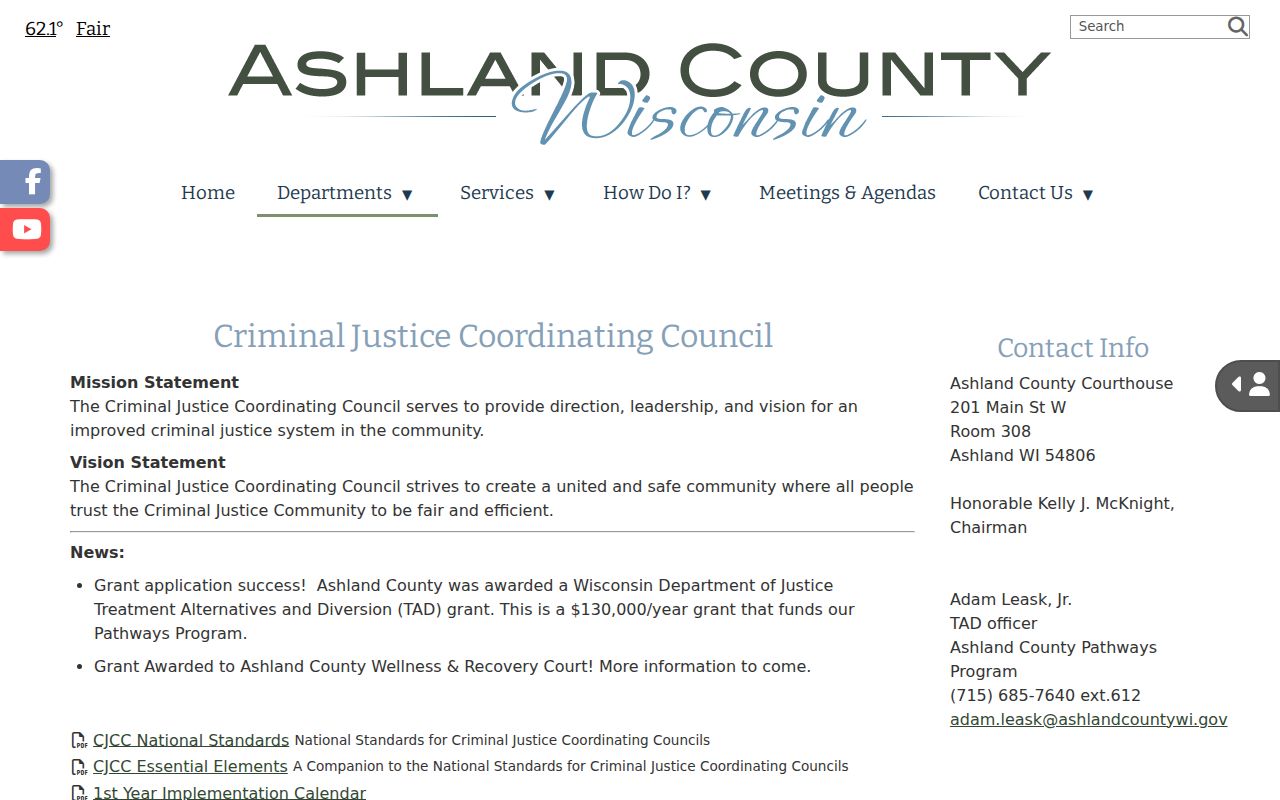
Use the phone, court, and direct-request chain when no public dashboard exists.
Public Access Laws in Wisconsin
The Wisconsin Public Records Law starts with a strong presumption of access, but it does not make every part of an Ashland County criminal file public. A request must reasonably describe an existing record. It need not use a special form or explain a motive. The custodian may redact protected victim details, juvenile material, personal identifiers, and information whose release would harm an active investigation. Wisconsin’s balancing test can also weigh a public interest in nondisclosure.
Ask for segregable public portions when the full record cannot be released. A written denial should identify the reason and review rights. Fees may reflect actual direct reproduction and certain location costs, but cannot be used to deter access.
Key Wisconsin laws:
Wis. Stat. §§ 19.31–19.39 establish request rights, custodians, fees, and the state presumption of public access.
Wis. Stat. § 165.83 governs criminal-history reporting into the Crime Information Bureau.
Wis. Stat. ch. 938 supplies the juvenile justice framework and restricts access to many juvenile records.
Wis. Stat. § 973.015 sets Wisconsin’s court-record expungement rules.
The official Wisconsin Legislature text shown below is the primary law used for Ashland County open-records requests.
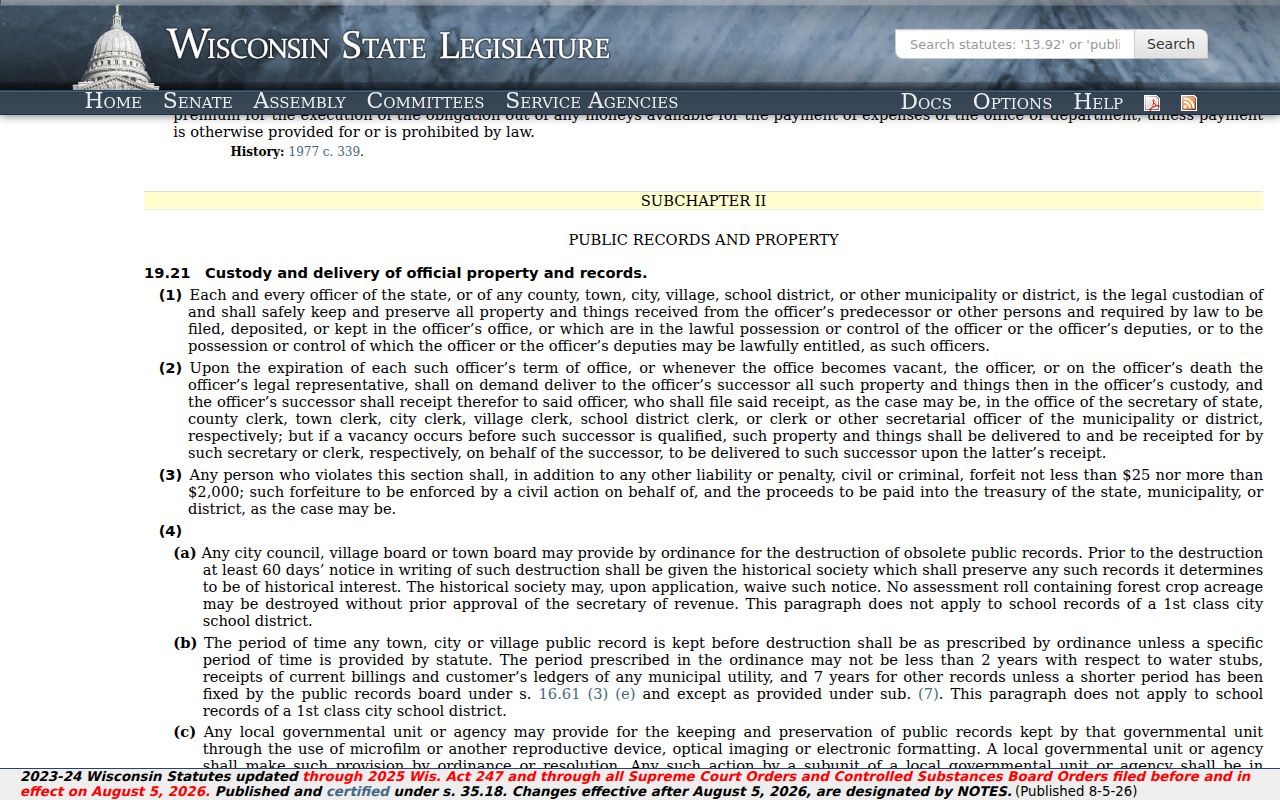
The statute supports access, while specific confidentiality rules and the balancing test still control individual records.
Ashland County Request Costs
The sheriff accepts requests in person from 8 a.m. to 4 p.m. on weekdays excluding holidays, by mail marked “Attention: Open Records,” or by email at openrecords@ashlandcountywi.gov. The office says most requests receive a reply within ten business days. Wisconsin law itself calls for a response as soon as practicable and without delay, so that local statement is an operational estimate, not a statewide deadline.
A precise request should give the incident number when known, date, location, involved person, requested record type, date range, and preferred delivery method. The sheriff form includes options for accident, incident, jail, video, photograph, audio, and citation records. Court copies use the clerk’s separate online form.
| Product | Published charge | Channel |
|---|---|---|
| Sheriff report | $0.25 per page | Counter, mail, or email request |
| CD or DVD | $5 | Sheriff request, with prepayment appreciated |
| Court record | $1.25 per page | Clerk’s online request |
| Certified court copy | $5 per document plus pages | Clerk’s online request |
| Staff court search | $5 when required | Clerk when the case must be found |
The CIB contact page is the support route for a WORCS request. Its assigned capture keeps the state help channel distinct from the Ashland County copy offices.
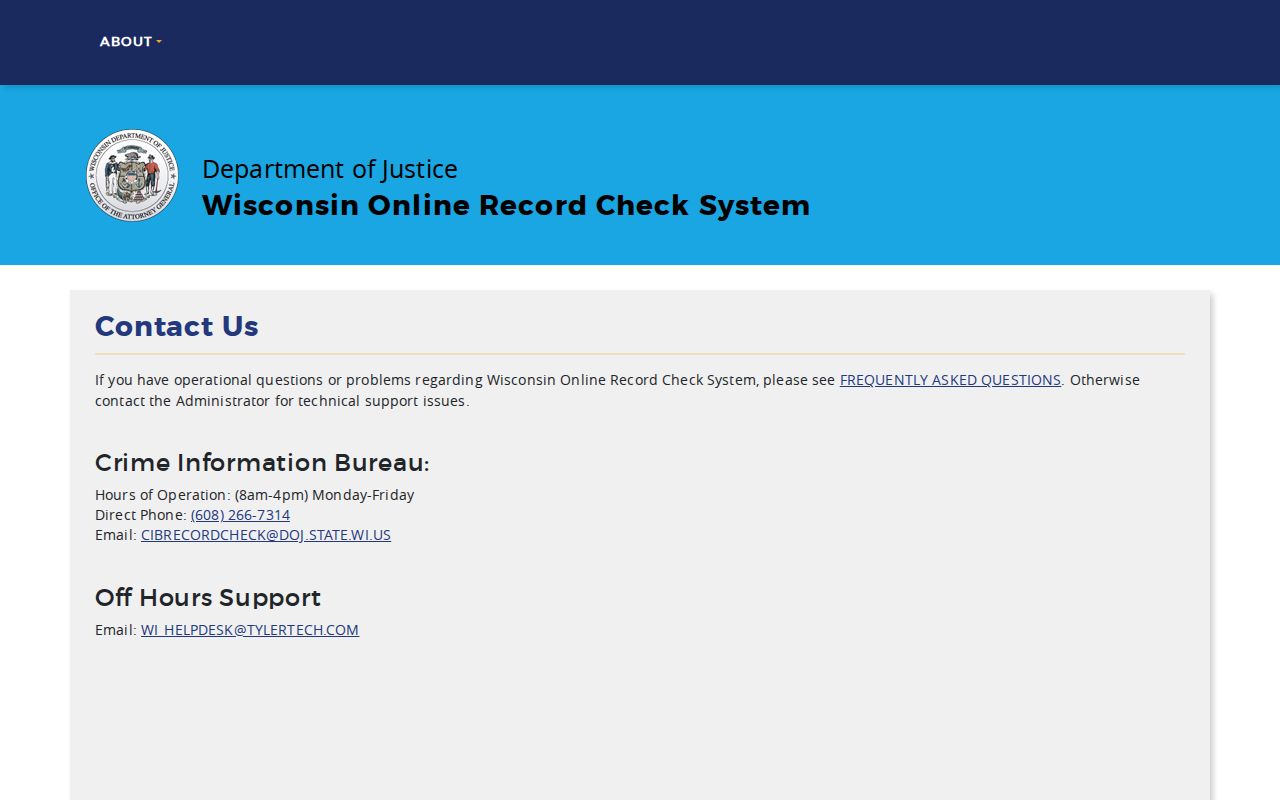
CIB support is available weekdays from 8 a.m. to 4 p.m. at 608-266-7314 or cibrecordcheck@doj.state.wi.us.
Sealed, Expunged, and Restricted Records
Wisconsin expungement under Wis. Stat. § 973.015 removes a qualifying circuit-court record from public view after successful sentence completion. Eligibility generally must have been ordered at sentencing. The law can reach certain convictions when the person was under 25 at the time of the offense, the maximum term met the statutory limit, and the offense was not excluded. The exact judgment and sentencing order control.
Expungement does not overturn the conviction or command the sheriff, prosecutor, Wisconsin DOJ, or FBI to destroy a parallel record. If an entry still appears, identify the database first. A WCCA display issue goes to the Ashland County clerk. A CIB entry uses the repository challenge route. An arrest report remains an agency record unless another law restricts it.
Juvenile cases follow a different statutory framework. Adoption records require a court order, and protected victim or investigative information may be withheld even when other parts of a file are public. A narrow request for public portions is often more useful than asking for an entire restricted file.
Ashland County Treatment Court Records
Ashland County’s Criminal Justice Coordinating Council supports Wellness and Recovery Court, Pathways, and Treatment Alternatives and Diversion work. These programs can generate assessments, referrals, compliance events, and court docket entries. They offer treatment-focused paths within the local justice system, but program completion does not by itself erase the original police, court, or CIB record.
The court file is the place to read the actual judgment and disposition. Program records may contain health, treatment, victim, or third-party information that is not public in full. The county’s TAD work is coordinated at the courthouse, while DOC or another agency may hold later supervision material. That split mirrors the larger Ashland County record flow.
A 2024 Wisconsin DOJ and DHS grant also provided $228,152 to the sheriff for opioid-use-disorder treatment for jail residents. The initiative affects services and may generate administrative records, but it should not be read as a new public jail roster or as proof about any individual.
Ashland County Criminal Records by City
Ashland County has exactly three incorporated places: the City of Ashland, City of Mellen, and Village of Butternut. Their local starting points differ. Ashland has a full municipal police department, while Mellen and Butternut require confirmation of the current service arrangement through their municipal offices. State criminal cases from all three places proceed through the county Circuit Court. Local custody goes through the Ashland County Jail.
The 2025 official population estimates are 7,927 for Ashland, 667 for Mellen, and 360 for Butternut. Those figures describe municipal scale, not crime. Each local page follows the right record custodian without inventing a municipal docket or police portal.
Ashland Criminal Records
7,927 in 2025 · Start with City Police for city-created reports.
Mellen Criminal Records
667 in 2025 · Confirm the report creator with City Hall.
Butternut Criminal Records
360 in 2025 · Village Hall and the sheriff route local requests.
Ashland County Records Across Distance
Ashland County’s 2025 population estimate is 16,203 across 1,044.97 square miles. About 15.3 people live in each square mile. Lake Superior, island travel, Bad River Reservation lands, forests, and state highways add real jurisdiction and travel questions. The result is a records system that depends heavily on phone, email, and statewide portals rather than many local municipal databases.
Crime figures must remain tied to an agency and year. Ashland Police, the county sheriff, and La Pointe Police report separately. A police offense count is not an arrest count, charge count, or conviction count. Partial-year sheriff data also cannot support a clean trend claim. The safest use of official statistics is to label the reporting agency, time span, and measure beside each number.
That same care applies to searches. A City of Ashland report may lead to a county booking and circuit case, then to a state repository entry. A DNR or State Patrol event may be prosecuted by the Ashland County District Attorney but still leave its originating report with the state agency. Geography changes the likely custodian, not the need to verify each link in the record chain.